The challenge before researchers, practitioners, policymakers, and industry is not simply to build smarter medical technologies, but to design socio–technical ecosystems that responsibly integrate these technologies into society.





The challenge before researchers, practitioners, policymakers, and industry is not simply to build smarter medical technologies, but to design socio–technical ecosystems that responsibly integrate these technologies into society.
The IEEE International Symposium on Ethics in Engineering, Science, and Technology (ETHICS) is a conference series sponsored by the IEEE Society on Social Implications of Technology (SSIT). Launched in 2014, ETHICS draws together the global, multicultural, interdisciplinary community of technology and ethics scholars and practitioners from industry, academia, government, and civil society.
As IEEE’s inaugural Ethics Week 2026 comes to a close, we celebrate a week that demonstrated our shared ethical values across the full spectrum of our organization.

As modern armed forces rely more heavily on data-driven intelligence systems and algorithmically assisted analysis, the risk emerges that errors originating in outdated information, flawed databases, or automation bias may propagate rapidly through the operational decision-making chain.
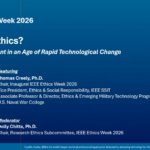
For the inaugural IEEE Ethics Week 2026, we present an interview with Dr. Tom Creely, 2026 Ethics Week Chair, exploring the question: “What is ethics?” Is it a set of rules? Compliance? Knowing right from wrong? Or a philosophical framework?

IEEE President Mary Ellen Randall calls upon members worldwide to join IEEE Ethics Week and take an active role in shaping the future of responsible, trusted technology for the benefit of humanity.

There has never been a more crucial moment for IEEE SSIT to lead this conversation on ethics across IEEE.

IEEE Ethics Week is a week dedicated to exploring the ethical questions that come with engineering, research, and technology, raising awareness, and having meaningful conversations.

DARRYL LEE PALMER JR. May 19, 1971 – August 30, 2026 was a visionary leader in the engineering world.

Celebrate IEEE Ethics Week by joining the IEEE Society on Social Implications of Technology (SSIT).

Join us for a discussion exploring the complex ethical challenges emerging in today’s rapidly evolving technological landscape and what these challenges mean for engineering education and practice.

The concept of broadcasting had its roots in a form of the telephone: a technique of narrowcasting where wealthy people could subscribe to have a second telephone line connected to their home.

IEEE Sections Congress 2026 in Glasgow, Scotland, August 23, 2026: Kerala, India, Section Chair Dr Manoj BS extends welcome to ISTAS26, Heather Love, IEEE SSIT VP Conferences.

The designers, engineers, and computer scientists we teach today will shape the systems of tomorrow–we need to teach them to center justice, not just solve problems.

When AI algorithms fail or deviate from their intended outcomes, resulting in negative impacts on society, they themselves cannot be held accountable since they are not moral agents. Although engineers may not be the sole owners of a language model, their involvement in the chain of operation requires a sense of collaborative accountability.
From the rapid deployment of transformative technologies like generative AI to the critical need for integrity in scientific publication, there has never been a more opportune time for IEEE to highlight the importance of ethical issues and ways to address them.
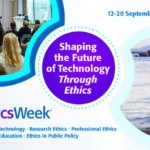
To meet this moment with a unified voice, the IEEE Society on Social Implications of Technology (SSIT) is proud to announce the launch of the first annual IEEE Ethics Week, to be held 12–20 September 2026. This initiative is funded by the IEEE Innovation Committee.

Aligning design with collective care refocuses requirements for development toward safety, accountability, and the real networks that deliver care. Until the design of digital technologies matches the accessibility and reliability of the paperbased binder system, the binder remains the more ethical coordination tool for communication and continuity in complex home care.
The Society on Social Implications of Technology (SSIT) is seeking nominations for three Member-at-Large (MaL) positions on its Board of Governors (BoG) for the 2027–2029 term.

Since many forms of lifestyle monitoring are “untraditional”—that is to say, they are novel, often experimental, and do not track hard quantifiable biomedical parameters—it is perhaps unsurprising that few options exist to defray costs for older adults and their care partners.

Webinar: Women as Ambassadors for a Better Future
 JOIN SSIT