IEEE President Mary Ellen Randall calls upon members worldwide to join IEEE Ethics Week and take an active role in shaping the future of responsible, trusted technology for the benefit of humanity.




IEEE President Mary Ellen Randall calls upon members worldwide to join IEEE Ethics Week and take an active role in shaping the future of responsible, trusted technology for the benefit of humanity.

Collective action problems can be resolved only through the coordination of individual actions and not through the unilateral action of any single individual. For this reason, such problems pose a distinctive challenge to engineering ethics educators: how to engage and motivate students to take seriously macro-ethical problems that they—as mere individuals—may lack sufficient incentive or power to resolve alone.

IEEE Ethics Week is a week dedicated to exploring the ethical questions that come with engineering, research, and technology, raising awareness, and having meaningful conversations.
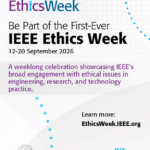
This September, IEEE SSIT is launching the first-ever IEEE Ethics Week, a worldwide celebration bringing together engineers, researchers, educators, students, and technology leaders to explore the ethical questions shaping today’s technologies and tomorrow’s innovations.

From the rapid deployment of transformative technologies like generative AI to the critical need for integrity in scientific publication, there has never been a more opportune time for IEEE to highlight the importance of ethical issues and ways to address them.
To meet this moment with a unified voice, the IEEE Society on Social Implications of Technology (SSIT) is proud to announce the launch of the first annual IEEE Ethics Week, to be held 12–20 September 2026. This initiative is funded by the IEEE Innovation Committee.

Whereas artificial intelligence and technological innovation continue to be heralded as producing ground-breaking advancements in society, the question of whether they will break free from Western technology’s cultural hegemony remains to be seen.

These modernists aim to cultivate in readers the capacity to “think cybernetically”—that is, to develop strategies for responding in creative and generative ways to the 20th century’s complex sociocultural (and socio-technical) environment.

The call for responsible innovation is a call to address and account for technology’s short- and long-term impacts within social, political, environmental, and cultural domains. Technological stewardship stands as a commitment to anticipate and mitigate technology’s potential for disruption and especially harm and to guide innovation toward beneficial ends. Dialogue and collaboration across diverse perspectives is essential for developing actionable technological solutions that attend in responsible ways to the evolving needs of society.
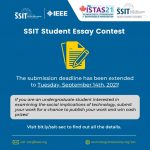
If you are an undergraduate student interested in examining the social implications of technology, submit your work for a chance to publish your work and win cash prizes!
ISTAS 2021 will be jointly hosted by the University of Waterloo and the University of Guelph (Ontario, Canada) in October 28-31, 2021. Submission Deadline July 13, 2021

A new archive of material added a new historical dimension to our discussions of cybernetics at the 2016 Norbert Wiener Conference in Australia.
 JOIN SSIT