



SSIT is pleased to be partnering with the IEEE Education Society and the National Institute for Engineering Ethics (NIEE) on the following webinar, which is presented as part of IEEE Ethics Week 2026 programming:
————-
__________
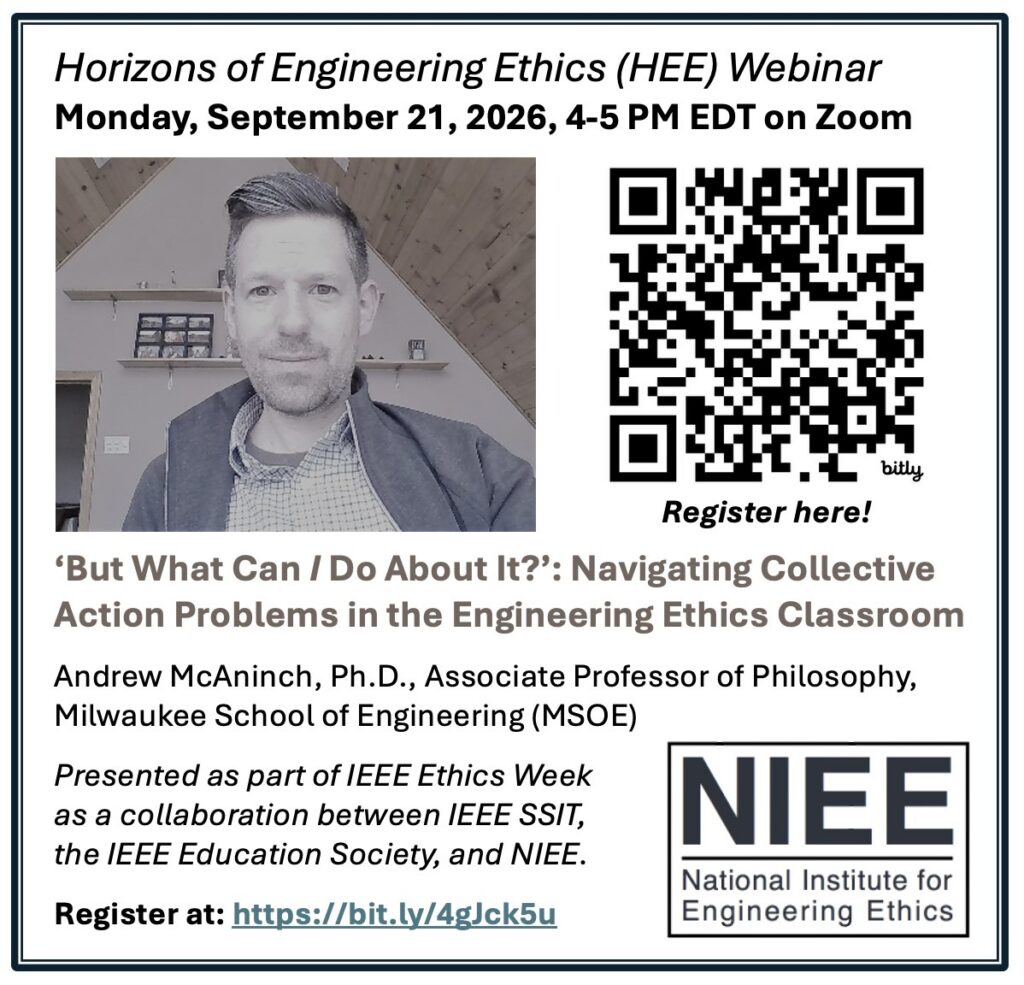
Horizons of Engineering Ethics (HEE) Webinar
Monday, September 21, 2026, 4-5 PM EDT on Zoom
‘But What Can I Do About It?’: Navigating Collective Action Problems in the Engineering Ethics Classroom
Andrew McAninch, Ph.D., Associate Professor of Philosophy, Milwaukee School of Engineering (MSOE)
Andrew McAninch, Ph.D., Associate Professor of Philosophy, Milwaukee School of Engineering (MSOE)
Presented as part of IEEE Ethics Week as a collaboration between IEEE SSIT, the IEEE Education Society, and NIEE.
Register at: https://bit.ly/4gJck5u
Abstract: Two categories of ethical problems bear on the conduct of engineering professionals. Micro-ethics concerns those problems individual engineers face within the narrow context of their professional practice: avoiding or disclosing conflicts of interest, maintaining employer or client confidentiality, upholding standards of honesty and integrity in one’s work and research, etc. Macro-ethics, on the other hand, concerns the broader social and environmental implications of engineering practices, where this might include, say, an examination of the ethical ramifications of emerging technologies both developed and deployed by engineers.
In this talk, I address a challenge facing those educators (like me) who seek to integrate macro-ethics alongside micro-ethics in engineering ethics education. Most micro-ethical problems speak to the permissibility of individual actions, and, even when they present dilemmas or represent competing values, they can be meaningfully addressed to an individual deliberating about what to do. Many macro-ethical problems, on the other hand, are collective action problems. One type of collective action problem involves instances in which each individual agent lacks rational incentive to do what (each acknowledges) would produce the best outcome for everyone, thus leaving everyone worse off. Another type involves instances in which no single member of a collective has the power to “make a difference” in changing some undesirable outcome produced by the collective (cf. Nefsky, 2017). The collective harm produced through individual acts of planet-warming fossil fuel consumption can be seen as an illustration of both types of problem.
Collective action problems like these can be resolved only through the coordination of individual actions and not through the unilateral action of any single individual. For this reason, such problems pose a distinctive challenge to engineering ethics educators: how to engage and motivate students to take seriously macro-ethical problems that they—as mere individuals—may lack sufficient incentive or power to resolve alone. How can educators make these problems practically relevant to students as deliberating agents? I articulate some different versions of the central challenge and offer some tentative approaches to addressing it.
Bio: Andrew McAninch, Ph.D., is an Associate Professor of Philosophy in the Department of Humanities, Social Science, and Communications at the Milwaukee School of Engineering (MSOE). Before arriving at MSOE, he was an Andrew W. Mellon Postdoctoral Teaching Fellow at the University of Pennsylvania, where he also spent a year as Program Director with the Center for Ethics and the Rule of Law (CERL) at the Penn Law School. He works in ethics and applied ethics and regularly teaches courses in engineering ethics, biomedical ethics, and ethics of artificial intelligence. He has served on MSOE’s AI Steering Committee, helping to develop responsible AI use policies on campus, and often speaks to professional societies and community organizations about ethical issues in the professions and the ethical implications of emerging technologies.
 JOIN SSIT